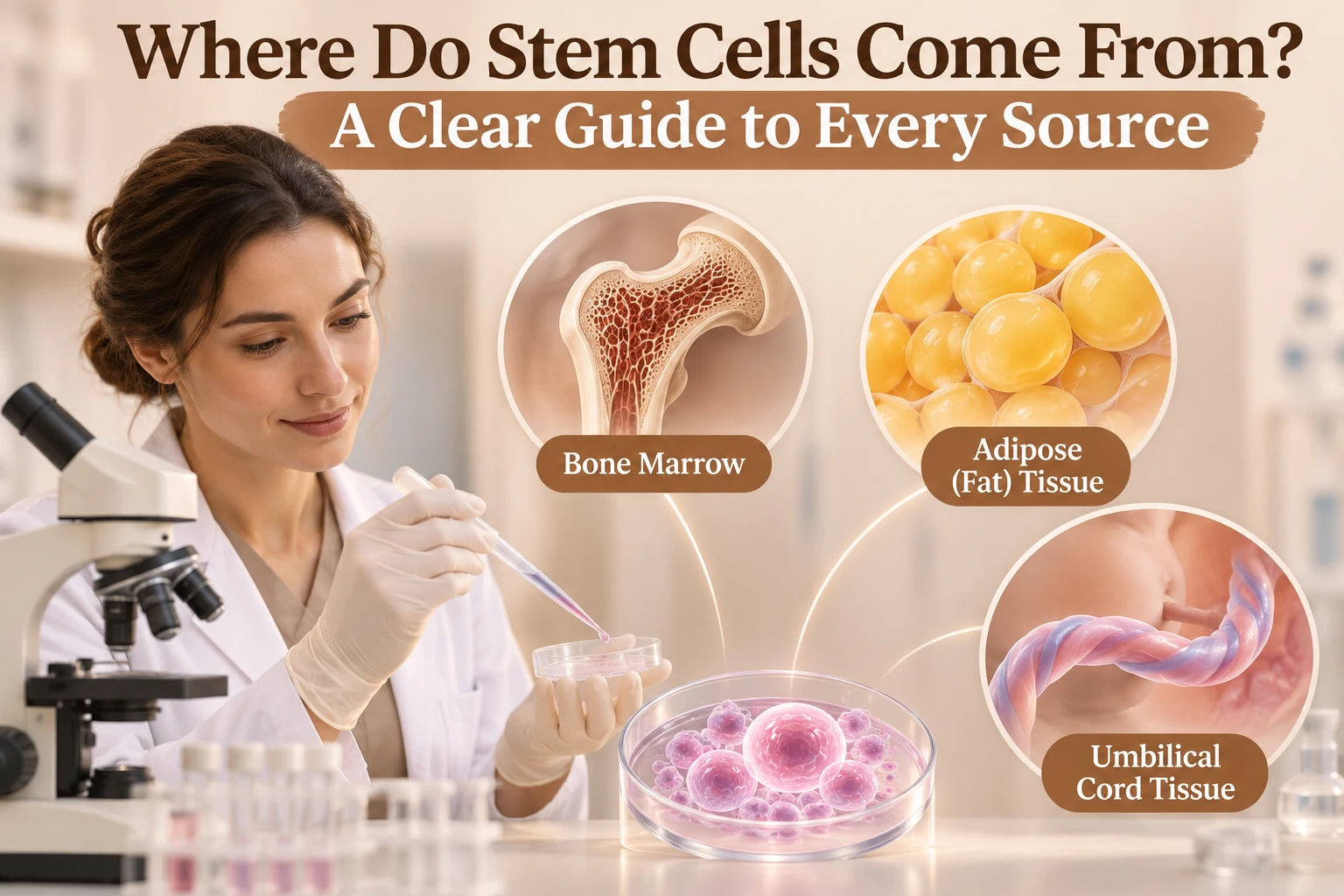
Stem cells come from four main sources: embryos, adult tissue such as bone marrow and fat, umbilical cord and placental tissue left over after birth, and ordinary adult cells reprogrammed in a lab.
Each source has different abilities, collection methods, and real-world uses.
Here’s how they differ and what that means if you’re thinking about stem cell therapy.
Patients who come to our Boca Raton clinic asking about stem cell therapy almost always start with the same question: where do stem cells come from?
It’s a fair question, and the answer shapes what a treatment can realistically do, how the cells are collected, and whether a given source is even legal to use.
Stem cells aren’t one single thing pulled from one single place.
They come from several different sources, and each one has its own strengths, limits, and role in medicine today.
SEE IF STEM CELL THERAPY IS RIGHT FOR YOU
What Are Stem Cells, Exactly?
Stem cells are the body’s raw material cells.
Every other cell with a specialized job, like a muscle cell, a blood cell, or a brain cell, starts out as a stem cell.
What makes them unique is their ability to divide and turn into many different cell types, which is why researchers and doctors are so interested in using them to repair damaged tissue.
Two properties set stem cells apart from regular cells.
They can renew themselves through repeated division, and they can differentiate, meaning they can turn into other, more specialized cell types.
That combination is what gives them their repair potential.
Where Do Stem Cells Come From?
Stem cells come from four main sources: embryos, adult tissue like bone marrow and fat, umbilical cord and placental tissue collected after birth, and ordinary skin or blood cells reprogrammed in a lab.
Each source offers a different balance of versatility, availability, and ethical consideration.
Embryonic Stem Cells
Embryonic stem cells come from a blastocyst, a small cluster of cells that forms about four to six days after fertilization.
These are typically extra embryos created during in vitro fertilization that would otherwise be discarded, and they’re donated for research with consent.
Because they can turn into nearly any cell type in the body, they’re considered the most versatile stem cell source, but their use is tightly regulated, which limits how often they appear outside of research settings.
Adult (Somatic) Stem Cells
Adult stem cells live inside tissue that’s already fully formed, quietly replacing and repairing cells throughout your life.
Adult stem cells circulate through the body and are maintained in specific tissue niches, which helps explain why bone marrow and fat tissue remain two of the most practical places to collect them.
They can’t turn into every cell type the way embryonic stem cells can, but they’re far easier to access and don’t raise the same ethical questions.
Perinatal Stem Cells (Umbilical Cord and Placenta)
Perinatal stem cells come from umbilical cord blood, cord tissue, and placental tissue collected right after a baby is born.
This tissue is usually discarded as medical waste, so collecting it doesn’t involve the same ethical concerns as embryonic sourcing.
These cells sit between embryonic and adult stem cells in versatility, and cord blood banking has become common enough that many parents now store it for possible future use.
Induced Pluripotent Stem Cells (iPSCs)
Induced pluripotent stem cells are created by reprogramming a patient’s own skin or blood cells in a lab so they behave like embryonic stem cells.
Because they come from the patient’s own tissue, they lower the risk of rejection and sidestep the ethical debate around embryos entirely.
Right now they’re used mostly in research and drug testing rather than approved clinical treatment, since reprogramming adds cost and complexity.
Embryonic vs. Adult Stem Cells: What’s the Real Difference?
The biggest difference is versatility versus accessibility.
Embryonic stem cells can develop into almost any cell type in the body, while adult stem cells are limited to becoming cells related to the tissue they came from.
Adult stem cells are easier, safer, and far more common to collect, which is why nearly all stem cell therapy used in clinics today relies on adult sources rather than embryonic ones.
Scientists describe this difference with two terms: pluripotent and multipotent.
Pluripotent cells, like embryonic stem cells, can become virtually any cell in the body.
Multipotent cells, like most adult stem cells, can only become a limited set of related cell types.
A bone marrow stem cell, for example, can become different types of blood cells, but it can’t become a brain cell or a muscle cell.
Where in the Body Are Adult Stem Cells Found?
Adult stem cells aren’t spread evenly through the body.
They cluster in a handful of specific locations, and two of them account for most of the stem cells used in medicine today.
Bone Marrow
Bone marrow stem cells are typically collected from the hip bones, which hold the richest concentration of marrow in the body.
These cells can develop into blood cells, bone, cartilage, and fat, making bone marrow one of the oldest and most established sources for stem cell treatment, including support for degenerative disc disease.
Adipose (Fat) Tissue
Fat tissue, collected through a minor liposuction procedure, contains a much higher concentration of stem cells per gram than bone marrow does.
That makes adipose tissue an increasingly popular source for regenerative treatments, especially for joint injections and orthopedic recovery, since a relatively small amount of fat can yield a large number of usable cells.
How Are Stem Cells Collected for Treatment?
The collection method depends entirely on the source.
Bone marrow is collected with a needle inserted into the hip bone, usually under local anesthesia.
Fat tissue is collected through a small liposuction procedure, often from the abdomen or thighs.
Blood-forming stem cells can also be pulled directly from the bloodstream through a process called apheresis, which separates the stem cells from the rest of the blood before returning everything else to the body.
Cord blood and tissue are collected immediately after childbirth and typically frozen for storage.
Once collected, the cells are processed in a lab to concentrate and prepare them before they’re ever used in a patient.
This is different from how stem cells compare to PRP therapy, which uses a patient’s own blood platelets rather than stem cells, even though the two are frequently confused.
What Are Stem Cells Used For Today?
Right now, stem cells are mainly used to treat blood cancers and blood disorders through bone marrow transplants, and increasingly to support healing in orthopedic, joint, and degenerative conditions through adult stem cell therapy.
Researchers are also studying stem cells for autoimmune disease, neurological conditions, and heart damage, though many of those uses are still in clinical trials rather than standard treatment.
Bone marrow and cord blood transplants have been used for decades to treat leukemia, lymphoma, and other blood disorders, and remain the most established use of stem cells in medicine.
Outside of blood disorders, adult stem cells are now used to support healing in a growing list of conditions:
- Joint pain and osteoarthritis
- Knee pain and cartilage wear
- Soft tissue injuries like tendon and ligament tears
- Autoimmune conditions
- Chronic wound healing
That demand is reflected in the numbers.
The global stem cell therapy market is projected to keep growing at a double-digit rate over the next several years, driven largely by demand for these adult cell treatments rather than embryonic research.
SEE IF STEM CELL THERAPY IS RIGHT FOR YOU
Are Stem Cell Treatments Safe and Regulated?
Adult stem cell treatments that use a patient’s own cells are generally considered low-risk when performed by a qualified physician, though the FDA has not approved stem cell therapy as a cure for most chronic conditions.
Treatments described as regenerative support are typically offered under physician oversight rather than as a guaranteed fix, and results vary from patient to patient.
It helps to separate research from treatment.
Embryonic stem cell research is tightly regulated and mostly confined to approved labs.
Adult stem cell treatment, using a patient’s own bone marrow or fat tissue, is available in clinical settings, but it’s still considered investigational for most non-blood conditions.
That doesn’t mean it isn’t worth considering, it means expectations should be realistic rather than promised.
A qualified clinic will evaluate your specific condition before suggesting stem cell therapy as an option, rather than treating it as a one size fits all solution.
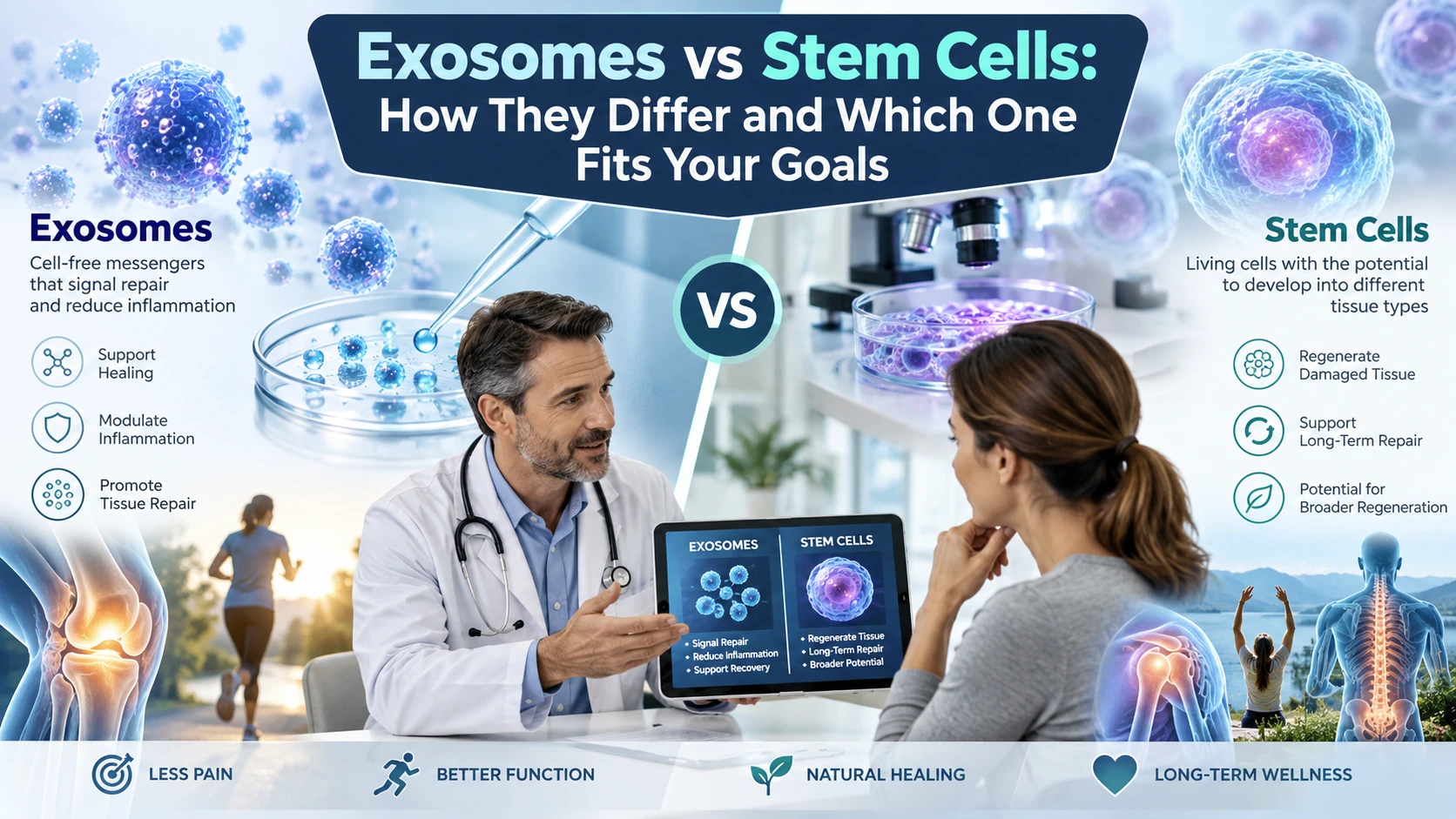
Cell-free alternatives like exosomes are also being studied as a lower-intervention option for patients who aren’t candidates for stem cell therapy itself.
How Aven Clinic Uses Stem Cells to Support Healing
At Aven Clinic, we work with three of the most practical adult stem cell sources.
Each patient’s treatment plan starts with a full evaluation, since which source and approach makes sense depends on the condition being treated and your overall health.
Our regenerative stem cell therapy program is built around this same idea: identify the right source, confirm you’re a good candidate, and set expectations based on your specific condition rather than a generic promise.
We offer this alongside our broader regenerative cell therapy options for patients managing joint pain, autoimmune conditions, and chronic injuries who want an alternative to surgery.
If you’re weighing stem cell therapy against other options, our team can also walk you through how long treatment typically takes to show results based on your condition, so you know what to expect before you start.
If you’re in the Boca Raton area and curious whether adult stem cell therapy fits your condition, Aven Clinic can walk you through a full evaluation and an honest look at what to expect before you commit to anything.
FAQs
Can stem cells come from your own body?
Yes. Adult stem cells are most often collected from your own bone marrow or fat tissue, which is why this approach is called an autologous treatment. Using your own cells lowers the risk of rejection since your body already recognizes them.
What’s the difference between cord blood and cord tissue stem cells?
Cord blood contains blood-forming stem cells, similar to what’s found in bone marrow, while cord tissue contains a different type called mesenchymal stem cells, which can support a wider range of tissue repair. Some families choose to bank both for different possible future uses.
Do stem cells decrease as you age?
Yes. The number and activity of stem cells in your body naturally decline with age, which is part of why older adults often heal more slowly than younger people. This is one reason researchers are interested in using externally sourced or processed stem cells to support healing later in life.
Which type of stem cell is used in regenerative medicine clinics?
Most regenerative medicine clinics, including Aven Clinic, use adult stem cells sourced from a patient’s own bone marrow or fat tissue. These sources are well studied, easier to collect than embryonic cells, and avoid the ethical and legal complications that come with embryonic sourcing.