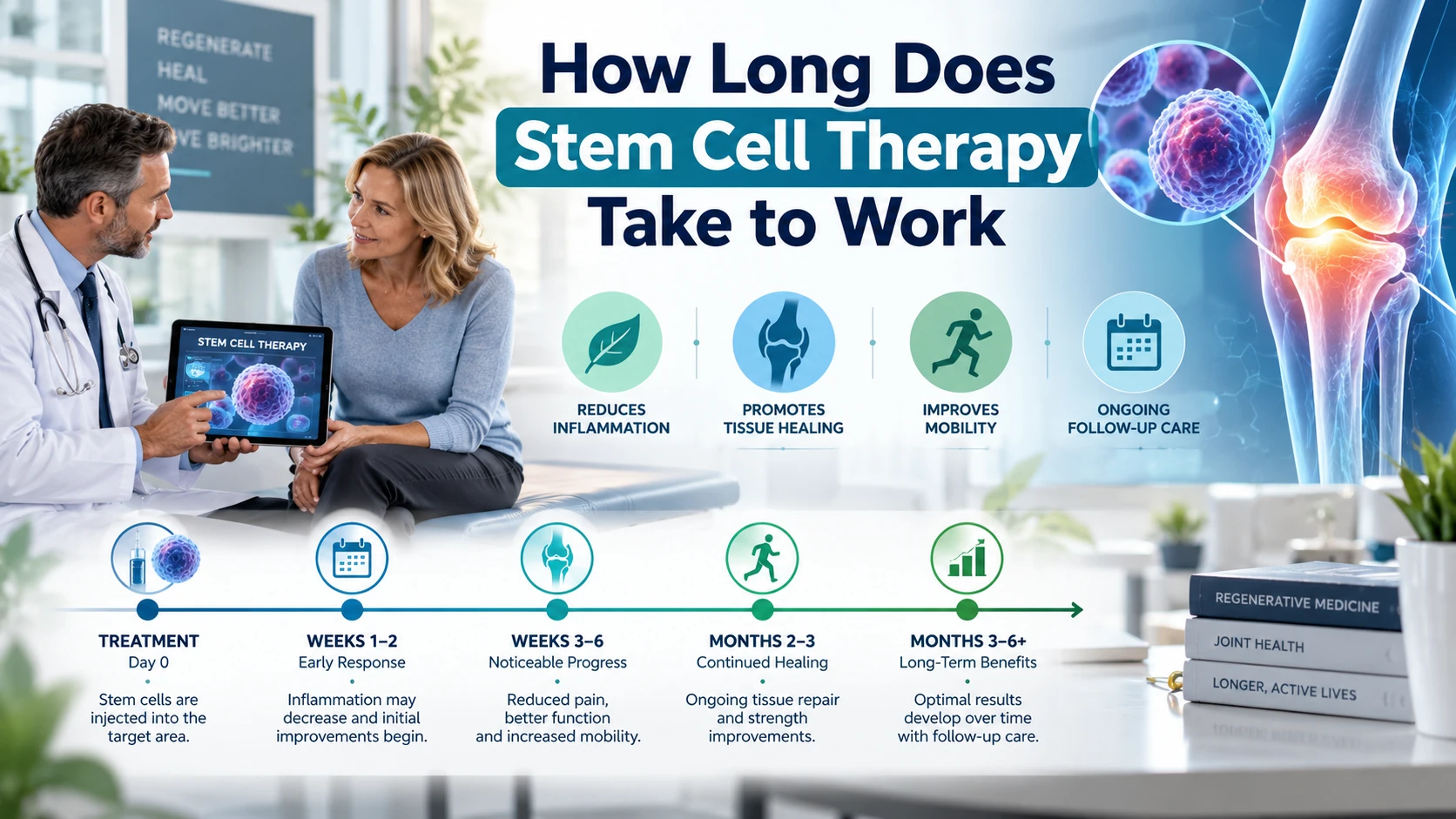
Most patients notice early changes within 2 to 6 weeks as inflammation drops and early tissue repair begins.
Full results typically build over 2 to 6 months and can keep improving for up to a year.
Knees tend to respond faster than the back or spine.
The exact timeline depends on your age, the severity of your condition, and the type of stem cells used.
If you’re considering stem cell therapy for a joint, your spine, or a chronic injury, the first question is almost always the same: how long does stem cell therapy take to work?
The honest answer depends on what you’re treating, but most people follow a fairly predictable pattern of recovery.
This guide walks through that pattern stage by stage, what’s actually happening inside your body during that time, and how long the benefits tend to last once they show up.
SEE IF STEM CELL THERAPY IS RIGHT FOR YOU
How Long Does Stem Cell Therapy Take to Work?
Most people begin noticing improvement within 2 to 6 weeks after stem cell therapy, as early inflammation subsides.
More noticeable gains in pain relief and mobility usually build over the following 2 to 6 months.
Some patients continue to see improvement for up to a year as deeper tissue remodeling keeps working in the background.
This general pattern holds across most orthopedic uses of stem cell therapy, including joints, tendons, and the spine.
The speed of improvement depends heavily on which condition is being treated and how far it has progressed.
Someone treated early for mild knee pain often responds faster than someone with years of joint degeneration.
It also depends on the type of stem cells used and how they were collected.
Mesenchymal stem cells taken from your own bone marrow or fat tissue (autologous cells) behave a bit differently than donor-derived (allogeneic) cells, and that difference can shift the timeline by weeks.
What Happens Inside Your Body After a Stem Cell Injection?
Once injected, mesenchymal stem cells travel to the site of injury or inflammation and start releasing growth factors and signaling molecules.
These signals calm the local immune response, reduce inflammation, and recruit your body’s own repair cells to the area.
The stem cells do less direct “rebuilding” than most people expect.
Their main job is coordinating a repair process your body already knows how to run.
Researchers describe this as an indirect, signaling-based effect rather than the cells physically turning into new cartilage or disc tissue, which is why mesenchymal stem cells are thought to work mainly through this paracrine signaling role instead of direct tissue replacement.
That distinction matters for setting expectations.
You’re not waiting for new tissue to visibly grow in real time.
You’re waiting for your body’s own repair systems to finish a job the stem cells helped start.
A Week-by-Week Timeline for Stem Cell Therapy Results
Here’s roughly what to expect at each stage, based on how most patients respond to mesenchymal stem cell injections for joint and spine conditions.
Weeks 1–2: Calming Inflammation
The first two weeks are mostly about inflammation control, not visible healing.
Some patients feel mild soreness or swelling at the injection site before anything else improves.
Range of motion is often the first thing to shift, with meaningful gains showing up during the first and second month after treatment in several controlled trials.
Weeks 3–6: Early Tissue Repair Begins
Between weeks three and six, many patients start noticing gradual pain relief and easier movement as early repair processes ramp up.
It’s also a good point to keep expectations realistic.
Over the first few months, stem cell injections show only a modest edge over placebo for pain and function in knee osteoarthritis according to a 2025 Cochrane review, so gains during this window tend to be real but incremental rather than dramatic.
Months 2–6: Peak Improvement
Most people hit their peak improvement somewhere between month two and month six.
A 2025 meta-analysis of randomized trials found that mesenchymal stem cell therapy produced significant improvement in standard pain and function scores at both six and twelve months compared to control treatment, which lines up with what most patients report feeling during this stretch.
Months 6–12+: Long-Term Remodeling
After six months, results tend to level off into a plateau rather than keep climbing sharply.
Structural changes, like what shows up on an MRI, can continue even after symptoms have stabilized.
In one long-term study, cartilage structure on MRI kept improving out to 18 months after a single injection, even though clinical symptom scores had already leveled off earlier.
How Long Does Stem Cell Treatment for Knees Take to Work?
Stem cell treatment for knees typically starts showing results within 4 to 12 weeks, with continued improvement over the following months.
The 2025 Cochrane review found measurable but modest benefits over placebo at the 6-month mark, with results varying significantly based on how advanced the osteoarthritis is.
Knee osteoarthritis is one of the most studied uses of stem cell therapy, partly because the knee is easy to inject directly and easy to measure with imaging and pain scores.
That’s also why the timeline data is more precise for knees than for almost any other joint.
How advanced your arthritis is matters more than almost any other factor.
Patients with earlier-stage changes on imaging tend to respond faster and more consistently than those with severe, bone-on-bone arthritis, where there’s little cartilage left to preserve.
If you’re weighing osteoarthritis treatment options for your knees, that staging conversation is usually one of the first things worth having before starting any regenerative treatment.
What Factors Affect How Fast Stem Cell Therapy Works?
How fast stem cell therapy works depends mainly on your age, the severity of your condition, the type and source of stem cells used, and how closely you follow post-treatment guidelines.
Younger patients with less advanced joint damage and strong aftercare adherence generally see faster, more consistent results than older patients with long-standing, severe degeneration.
Age changes how quickly your own tissue can respond to the healing signals stem cells send out.
Older tissue simply doesn’t mount a repair response as fast as younger tissue, even with the same injection.
Severity matters just as much.
A joint with early cartilage thinning has more to work with than one that’s already lost most of its cushioning, which is part of why results vary so widely between patients with the same diagnosis.
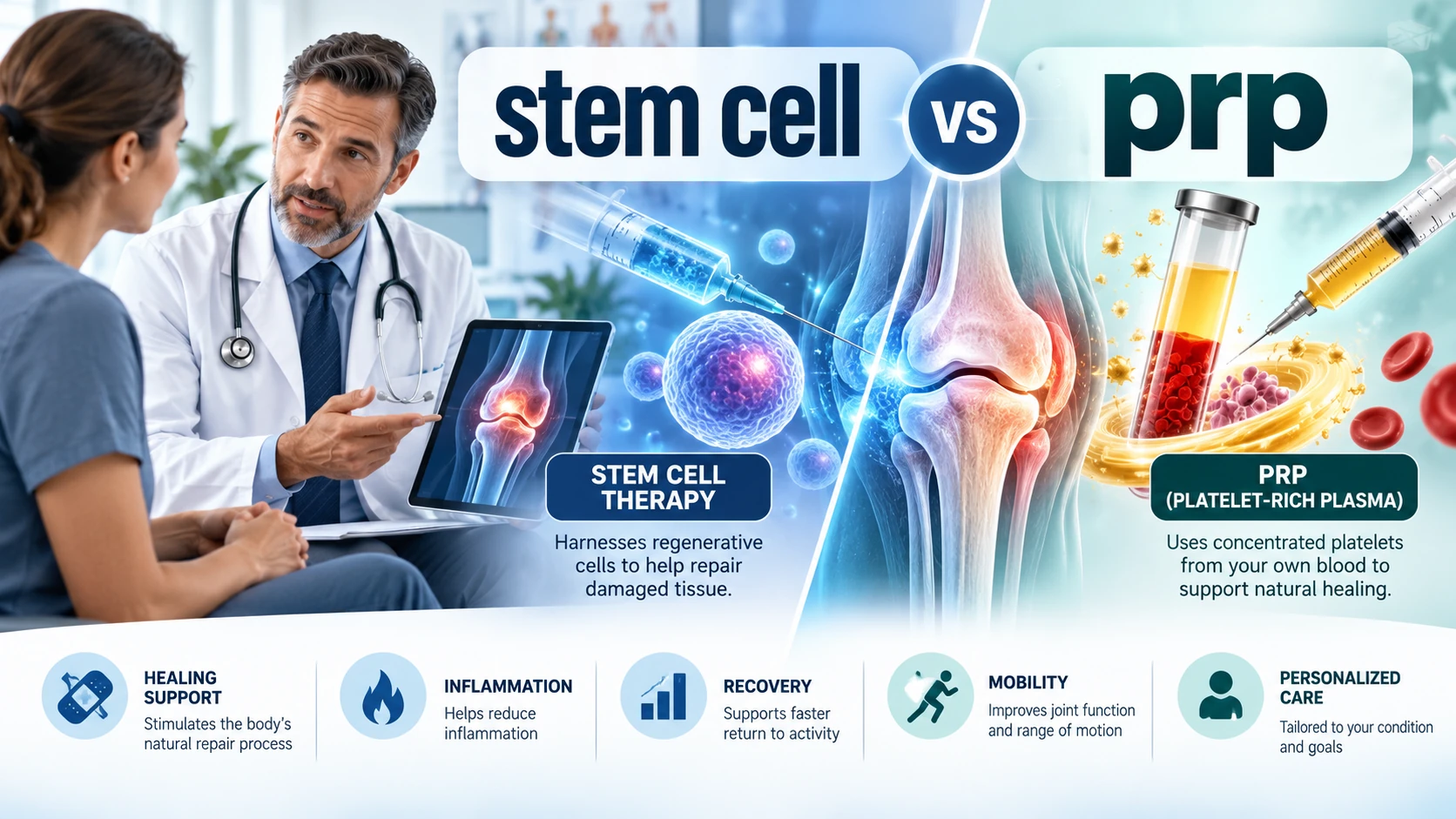
Where the cells come from and how they’re prepared changes the timeline too, which is one reason providers sometimes recommend PRP joint injections as a complementary or alternative option depending on your condition and goals.
Your own behavior after treatment plays a bigger role than most people expect.
A growing body of research points to contextual factors, meaning things like rehab adherence, expectations, and overall health, as a major driver of how much symptom improvement patients actually experience after an injection, not just the biology of the cells themselves.
How Long Do Stem Cell Therapy Results Last?
Stem cell therapy results commonly last anywhere from six months to several years, depending on the condition treated and how it’s maintained.
Most of the durability research comes from knee osteoarthritis, where a majority of patients report lasting improvement well beyond the one-year mark.
In one systematic review following patients for two years after treatment, 87.9% reported improvement at the 24-month mark, with over half describing themselves as much improved rather than just slightly better.
Durability isn’t unlimited, though.
A seven-year study of knee osteoarthritis patients found that clinical scores stayed improved through roughly five years before declining back toward baseline by the seven-year mark, a useful reminder that stem cell therapy manages a degenerative condition rather than curing it outright.
That’s also why many patients plan for maintenance injections every couple of years rather than expecting one treatment to last indefinitely.
SEE IF STEM CELL THERAPY IS RIGHT FOR YOU
Stem Cell Therapy Timelines for Back, Spine, and Other Joint Pain
Knees get most of the research attention, but stem cell therapy is also used for degenerative disc disease, chronic back pain, and joints like the shoulder, hip, and ankle.
The timeline looks similar, just shifted slightly later.
For lumbar disc issues, one feasibility study following patients after low-dose mesenchymal stem cell injections found meaningful pain reduction emerging by the three-month mark, with continued improvement tracked out to a year.
A broader review of randomized trials for degenerative disc disease found a similar pattern of gradual improvement in pain and disability scores over the following months, rather than the faster early response sometimes seen in knees.
If you’re dealing with degenerative disc disease or chronic back pain, it’s worth setting expectations around months rather than weeks for the earliest noticeable changes.
The same general pattern holds for other joints.
Conditions like ankle osteoarthritis tend to follow a timeline close to what’s seen in knees, since the underlying joint biology is similar, though smaller joints sometimes respond a bit faster simply because there’s less tissue involved.
How Aven Clinic’s Regenerative Medicine Program Supports Your Recovery
At Aven Clinic in Boca Raton, regenerative treatment starts with understanding why a joint or disc is struggling in the first place, not just masking the symptom.
That root-cause approach shapes how our stem cell therapy program is built around your specific condition, age, and health history rather than a one-size-fits-all protocol.
Because timeline and outcome depend so heavily on individual factors, our team reviews your imaging, prior treatments, and overall health before recommending a plan, so you know what realistic progress should look like for your situation.
We also help coordinate the aftercare steps, like activity modifications and follow-up monitoring, that research shows make a real difference in how well and how quickly results show up.
If you’re trying to figure out whether stem cell therapy makes sense for your knees, back, or another joint, the clearest next step is a conversation with someone who can look at your actual case.
You can schedule a consultation with our team to go over your options and get a realistic timeline for your situation.
FAQs
How soon after stem cell therapy can I feel a difference?
Most patients notice their first changes within 2 to 6 weeks, mainly as inflammation drops. More noticeable improvement in pain and mobility usually builds over the following 2 to 6 months.
Does stem cell therapy work faster for knees than for the back or spine?
Generally yes. Knee osteoarthritis tends to respond within weeks to a few months, while degenerative disc disease and back pain often take a bit longer, with meaningful change more commonly reported around the three-month mark.
What happens if I don’t notice improvement after a few months?
It’s worth a follow-up with your provider to reassess imaging and discuss whether a second injection, a different cell source, or an adjunct treatment like PRP makes sense. Not responding in the expected window doesn’t necessarily mean the treatment failed completely, but it does mean your plan may need adjusting.
Can I speed up my stem cell therapy results?
You can’t speed up the biology, but you can avoid slowing it down. Following your provider’s activity guidelines, avoiding anti-inflammatory medications when advised, and attending any recommended follow-up therapy all support a faster, more complete response.
Is stem cell therapy a one-time treatment, or will I need repeat injections?
Many patients get lasting relief from a single treatment for six months to a few years, but some conditions, especially advanced osteoarthritis, respond better to maintenance injections every one to two years.
How do I know if a stem cell clinic is legitimate and FDA-compliant?
Ask what type of cells are used, whether they’re your own (autologous) or donor-derived (allogeneic), how much they’re processed before reinjection, and how that fits within FDA guidelines. A legitimate provider will answer these questions clearly and won’t promise guaranteed cures for unrelated conditions.