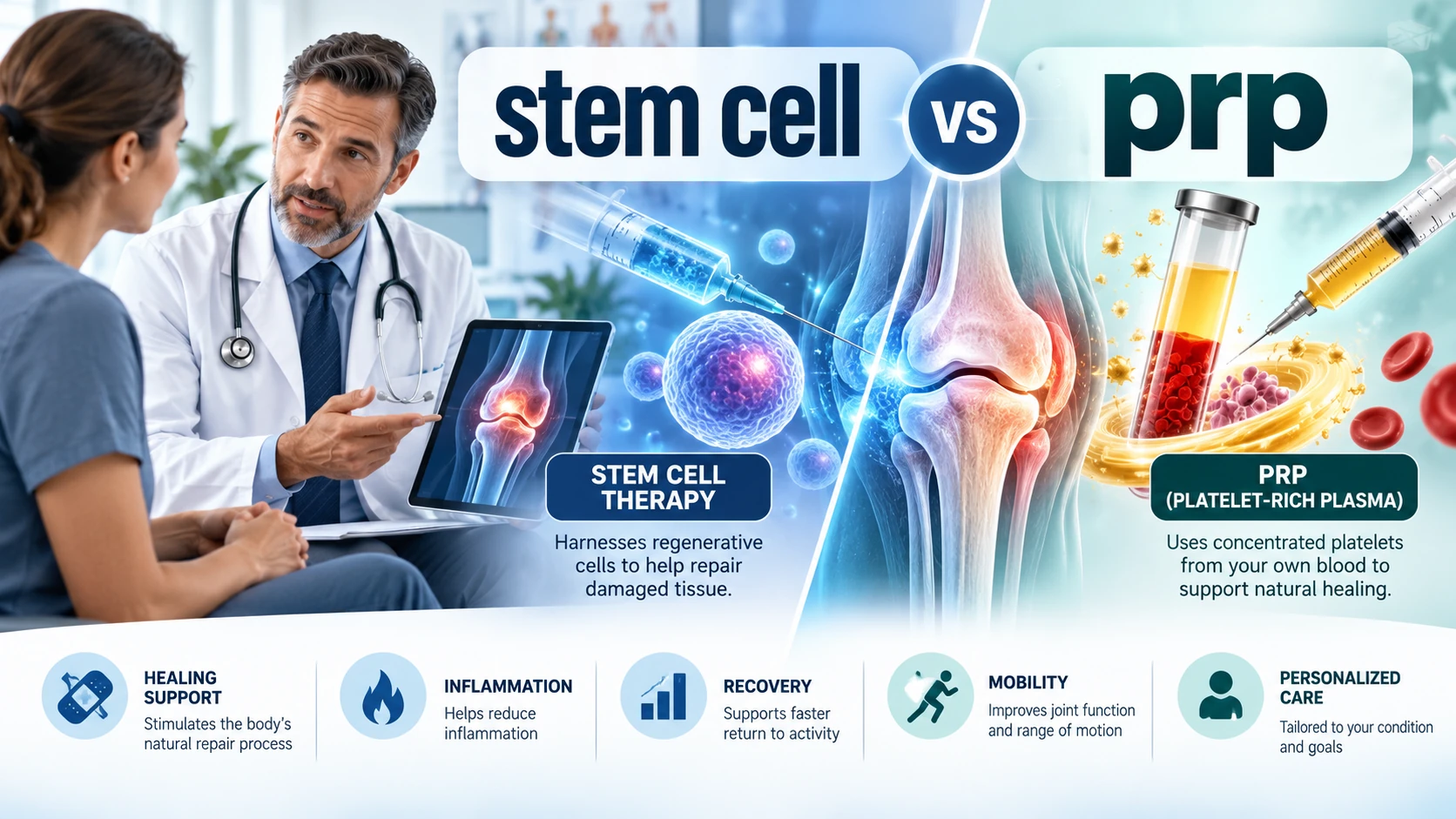
PRP uses concentrated platelets from your own blood to send healing signals to damaged tissue, while stem cell therapy introduces cells that can actually grow into new tissue.
PRP tends to work best for mild to moderate injuries and typically costs less, while stem cells are often chosen for deeper joint damage.
Your condition, your goals, and your budget decide which one fits you.
If you have joint pain, a stubborn tendon injury, or early arthritis, you’ve probably run into two treatment names over and over: stem cell therapy and PRP.
Both fall under the umbrella of regenerative medicine, and both use tools your own body already makes instead of surgery or steroid shots.
When people start comparing stem cells vs PRP, they’re usually just trying to figure out which one actually fits their injury.
But stem cell vs PRP isn’t really a question of which one is better.
It’s a question of which one matches your condition, your timeline, and your budget.
Here’s what actually separates them, what the research says, and how to think through the decision.
SEE IF PRP OR STEM CELL THERAPY IS RIGHT FOR YOU
What Is the Difference Between Stem Cells and PRP?
PRP, short for platelet-rich plasma, concentrates platelets from your own blood to release growth factors that speed up healing.
Stem cell therapy uses cells, usually pulled from bone marrow, fat, or umbilical tissue, that can develop into new cartilage, tendon, or disc tissue.
PRP sends a healing signal.
Stem cells help rebuild the tissue itself.
Think of PRP as a messenger and stem cells as raw building material.
PRP tells your existing cells to work harder and heal faster.
Stem cells can, in some cases, become the replacement tissue your body is missing.
That one distinction drives almost every other difference between the two treatments, from cost to recovery time to which conditions each one treats well.
How Does PRP Therapy Work?
PRP therapy starts with a simple blood draw, the same as a routine lab test.
The blood goes into a centrifuge that spins out the platelets and separates them from red and white blood cells.
That concentrated platelet solution is then injected directly into the injured area.
Platelets carry over 800 different proteins that act on surrounding cells to trigger repair, including the stem cells, fibroblasts, and other tissue-building cells already present in the area.
The whole process, from blood draw to injection, usually takes less than an hour.
Many clinics offer PRP joint injections as a same-day outpatient treatment for tendonitis, bursitis, and early-stage joint pain.
How Does Stem Cell Therapy Work?
Stem cell therapy uses mesenchymal stem cells, a type of cell capable of developing into bone, cartilage, tendon, or fat tissue depending on what the body signals it to become.
These cells are most often harvested from your own bone marrow or fat tissue, though some clinics use donor-derived cells from umbilical cord tissue.
Research shows these cells can potentially differentiate into as many as 200 different cell types, which is why stem cell therapy is often considered for more advanced tissue damage than PRP alone can address.
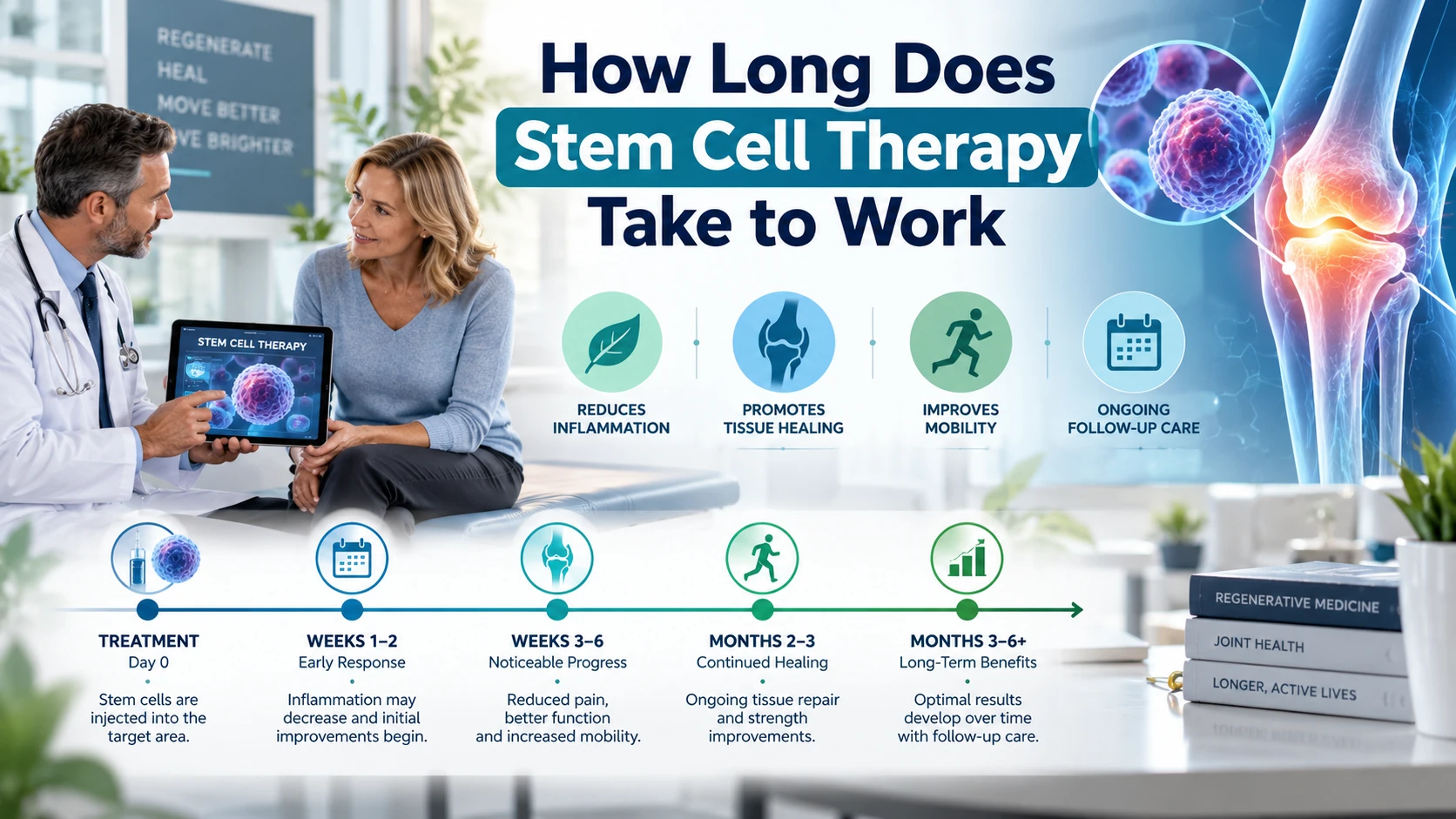
After collection, the cells may need processing before they’re injected back into the damaged area, which can add several days to the timeline compared to PRP.
Clinics offering stem cell therapy typically build the treatment plan around the specific joint, disc, or tissue involved.
Stem Cell vs PRP: Source, Timeline, and Mechanism at a Glance
Here’s how the two treatments stack up side by side on the factors that matter most when you’re deciding between them.
| Factor | PRP | Stem Cell Therapy |
|---|---|---|
| Source | Your own blood platelets | Bone marrow, fat tissue, or donor umbilical tissue |
| How it works | Releases growth factors that signal healing | Can develop into new tissue directly |
| Processing time | Same day, usually 30 to 60 minutes | Same day to several days, depending on processing |
| Best suited for | Mild to moderate injuries | More advanced tissue or joint damage |
| General cost range | Lower | Higher |
Neither treatment is automatically the “stronger” option.
A mild tendon strain treated with stem cells isn’t necessarily going to heal better than it would with PRP, and advanced cartilage loss treated with PRP alone may not get the regenerative support it actually needs.
Which Conditions Respond Better to PRP vs Stem Cells?
PRP tends to work well for conditions where tissue is irritated or healing slowly but is still largely intact, while stem cells are usually reserved for cases where tissue has broken down or degenerated significantly.
When PRP Is Usually Enough
PRP is commonly used for tendonitis, bursitis, mild to moderate osteoarthritis, ligament sprains, and slow-healing injuries after sports or overuse.
If the tissue is inflamed or strained but hasn’t broken down structurally, PRP’s growth factors are often enough to accelerate the body’s own repair process.
When Stem Cells Make More Sense
Stem cells are typically considered for more advanced cartilage loss, significant tendon or ligament tears, and chronic joint degeneration where there’s actual tissue loss to replace rather than just inflammation to calm down.
Spinal conditions involving disc breakdown are another common use case.
Patients exploring options for degenerative disc disease often look at stem cells specifically because PRP alone has less to work with once the disc itself has thinned or dried out.
Is Stem Cell Therapy Better Than PRP for Osteoarthritis?
Not necessarily.
For many patients with mild to moderate knee osteoarthritis, research has found no meaningful long-term advantage of stem cells over PRP.
A Mayo Clinic analysis of bone marrow stem cell and PRP injections for knee osteoarthritis found that patients with mild arthritis improved similarly with either treatment, while patients with moderate to severe arthritis saw a brief edge with stem cells at six months that disappeared by the one and two year mark.
That doesn’t mean stem cells are pointless for arthritis.
It means the severity of the joint damage, not personal preference, should guide the choice.
This same logic applies beyond the knee.
Patients dealing with ankle osteoarthritis face a similar decision between calming inflammation with PRP and attempting deeper tissue support with stem cells, depending on how far the joint damage has progressed.
Are PRP and Stem Cell Therapy Safe and FDA Approved?
PRP is generally considered low risk since it uses your own blood, and the main concerns are injection site soreness or infection.
Stem cell therapy carries similar injection risks, plus added variability depending on where the cells came from and how they were processed.
On the approval question, it’s worth being direct: the FDA has only approved stem cell products derived from umbilical cord blood, and only for blood-related disorders, not for joints, discs, or sports injuries.
Orthopedic stem cell and PRP procedures using your own minimally processed cells generally fall under a separate regulatory framework rather than full drug approval.
That’s not a reason to avoid either treatment, but it is a reason to ask any clinic exactly where their cells come from and how they’re processed before you commit.
Can PRP and Stem Cell Therapy Be Combined?
Yes, and for some patients it’s actually the better strategy than choosing one or the other.
Research shows that PRP and stem cells can complement each other, with PRP creating a healthier environment for stem cells to multiply and develop into the tissue type the body needs.
A clinical trial comparing stem cells enhanced with PRP against PRP alone for knee osteoarthritis reflects growing interest in this combined approach.
Some providers build combined protocols into their broader regenerative cell therapy programs specifically for patients whose damage sits in that middle zone, not mild enough for PRP alone, not severe enough to need stem cells by themselves.
How Aven Clinic Helps You Choose Between PRP and Stem Cells
We don’t believe in offering one treatment to every patient who walks through the door.
At Aven Clinic, we start by looking at what’s actually happening in the joint, disc, or tissue causing your pain, not just the symptom you came in with.
For patients whose damage is mild to moderate, we often recommend starting with PRP joint injections drawn directly from your own blood.
For patients with more advanced degeneration, we build a personalized stem cell plan, sourcing cells from bone marrow, fat tissue, or umbilical tissue depending on what fits your situation and goals best.
If you’re local to South Florida, our team also works closely with patients seeking osteoarthritis treatment in Boca Raton, walking through imaging, history, and goals together before recommending a path forward.
We’d rather tell you honestly which treatment fits your case than sell you the more expensive one.
Choosing between stem cell therapy and PRP doesn’t have to be a guessing game.
With the right evaluation, you can walk in with a clear, honest answer about which treatment actually fits your body and your budget, and Aven Clinic is here to help you get there.
FAQs: PRP vs Stem Cell Therapy
Is stem cell therapy better than PRP for arthritis?
Not automatically. Research shows similar outcomes between the two for mild to moderate arthritis over the long term, with stem cells offering only a brief, short-lived edge for more severe cases. The right choice depends on how advanced the joint damage is.
How long do PRP and stem cell injection results last?
Results vary by patient and condition, but PRP effects often last several months to a year, while stem cell results can last longer in cases involving tissue regeneration rather than just inflammation reduction. Some patients need repeat sessions of either treatment.
Can PRP and stem cell therapy be combined in one treatment plan?
Yes. Combining the two is increasingly common, since PRP can create a better environment for injected stem cells to grow and develop into the tissue a joint or disc needs.
Which has more research support, PRP or stem cell therapy?
Both have a growing body of research, but PRP has been studied longer and more extensively in clinical settings. Stem cell therapy research is expanding quickly, especially for combined treatment approaches.
How many PRP or stem cell sessions will I need?
It depends on the condition and how it responds. Some patients see meaningful improvement after a single session, while others benefit from a series of injections spaced weeks apart. Your provider should set expectations based on your specific case, not a standard package.